
Optical Fibers | Can a fishing line or a water stream be turned into optical fibers to transmit the internet? Discover the physics of light and Total Internal Reflection through amazing DIY experiments.
From Fishing Line to the Internet: Can We Make DIY Optical Fibers?
Creating DIY Optical Fibers:
Exploring the Physics of Light and Data Transmission in a Simplified Scientific Style
1. Fishing Line as a Light Guide: The Scientific Beginning
From a physics perspective, a transparent fishing line (especially one made of fluorocarbon) can act as a simple “conductor” for light. This relies on a phenomenon called Total Internal Reflection (TIR). When light enters one end of the line at a specific angle, it bounces off the inner walls rather than exiting through them, allowing it to emerge from the other end even if the line is curved.
Why isn’t fishing line considered a “true” optical fiber?
Professional optical fibers consist of two parts: the Core and the Cladding. The cladding has a lower refractive index, acting like a mirror that traps light inside with $100\%$ efficiency. A fishing line, however, is a “core” without “cladding,” which leads to light leakage as soon as it is touched or scratched.
2. The “Light Fountain” Experiment: When Water Becomes a Cable
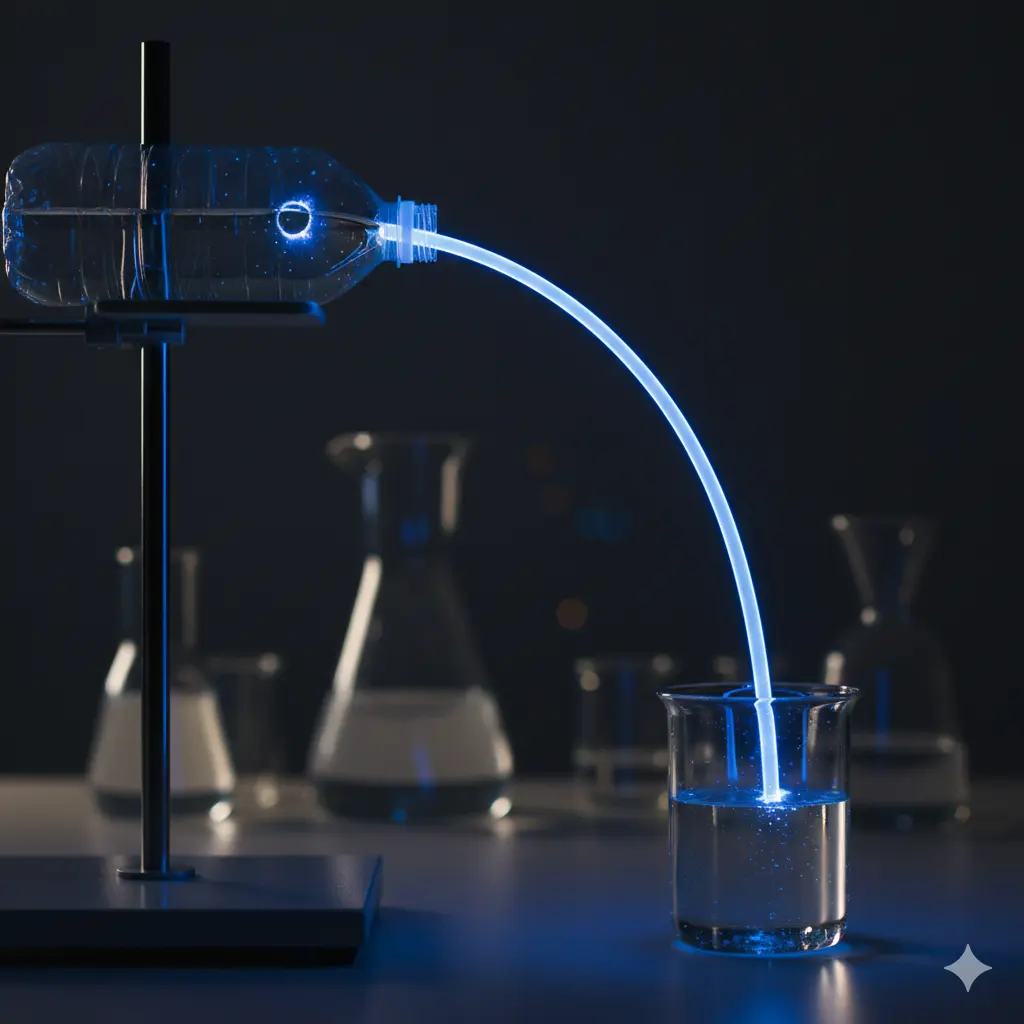
Did you know that distilled water can sometimes be a better light guide than plastic? A simple experiment using a water bottle and a laser can prove that liquids are capable of carrying light.
DIY Experiment:
- Poke a small hole in the side of a plastic bottle filled with water.
- Aim a laser beam directly from the opposite side of the hole.
- The Result: The laser beam will bend along with the flowing stream of water, creating a stunning visual effect known as a “Light Fountain.”
3. Can We Transmit Internet Through “Water Taps”?
Theoretically, the answer is Yes. In the world of technology, data is nothing more than binary pulses ($0$ and $1$). If we could make a laser flicker at high speeds behind a water stream and receive these pulses with a photosensor at the other end, we could transmit data.
However, in practice, this idea faces massive hurdles:
- Turbulence: Air bubbles in the water scatter the light.
- Absorption: Water molecules absorb light energy much faster than glass does.
- One-way connection: Water flows only downwards, whereas the internet requires both upstream and downstream connections.
4. Developing the Concept: Liquid Core Optical Fibers (LCOF)
Some have proposed an advanced engineering idea: creating a hollow fishing line, filling it with distilled water, and coating it with a reflective material. Would this succeed in transmitting data for thousands of kilometers?
| Comparison Factor | Silica Glass Fiber | Proposed Water Fiber |
|---|---|---|
| Transparency | Ultra-high (minimal light absorption) | Low (water absorbs radiation) |
| Reflection Method | Total Internal Reflection (Zero loss) | Metallic reflection (Loses $1\%$ per hit) |
| Stability | Resistant to heat and pressure | Affected by freezing and leakage |
“The reason glass remains superior is its immense chemical purity; light can travel for dozens of kilometers in silica glass before needing amplification—a feat that water or ordinary plastic simply cannot achieve.”
The Bottom Line:
Fishing lines and water streams are fantastic educational tools for understanding the physics of optics. They can be used in short-range applications (like decorative lighting or medical sensors). However, when it comes to transmitting the internet across continents, specialized glass remains the king of technology thanks to its unique physical properties.
This article was prepared as part of an exploratory journey into the physics of light.
Other links:
How to Limit and Increase Internet Speed from the Router
Finding the Router IP from Mobile and Computer
A Comprehensive Guide to Router Maintenance
Converting Arduino into a Professional CNC Machine
What are the Best Types of NVIDIA Graphics Cards?